
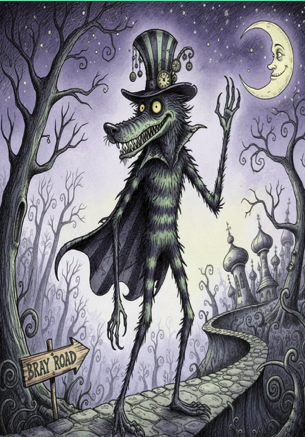
Every town has a road people talk about differently after dark.
In daylight, it is just a road. A bend near trees. A stretch with no houses. A shortcut. A place you have driven a hundred times. At night, though, the same road turns into a stage set for folklore. Distances feel wrong. Tree lines move. Headlights create islands of certainty surrounded by black space. And suddenly every story you ever heard about that area feels more possible than it did an hour ago.
This is exactly why forest roads produce such durable urban legends.
First, they are threshold spaces. They are not fully wild, but they are not fully controlled either. You are still in a human-made structure — the road — but only barely. Everything beyond the shoulder belongs to cover, shadow, depth, and uncertainty. That border condition is where folklore thrives. It gives the mind just enough structure to navigate and just enough darkness to invent.
Second, forest roads manipulate visibility in brutal ways. Your headlights illuminate a narrow cone. Outside that cone, detail drops fast. Inside it, branches can look like limbs, stumps can look like crouched figures, and reflected light can become eyes for half a second. The brain is doing what it is built to do: detect patterns, identify threats, and fill gaps quickly. Most of the time, that keeps people safe. In the wrong mood, on the wrong road, it creates a story.
Third, sound behaves differently in these places. Engine noise, insects, wind, loose gravel, and tree movement all compete in weird layers. A snapped branch or distant call can feel much closer than it is. Silence can feel louder than noise. And when people cannot confidently map a sound source, imagination moves in fast.
That does not mean every roadside legend is “just in people’s heads.” It means the environment is naturally built to generate memorable experiences — some explainable, some not, many unresolved. Folklore loves unresolved.
There is also a social reason these roads become legendary: they are shared spaces with repeat witnesses. A single haunted room in a private house may produce one family story. A road gets generations. Teenagers, shift workers, truck drivers, locals taking shortcuts, people lost at night — all using the same strip of asphalt, all carrying stories forward with slight changes. That is how legends stabilize while still evolving.
Cryptid sightings fit perfectly into this structure. Roads near treelines create ideal conditions for brief encounters: a shape crossing, a figure standing still at the edge of light, eye shine from a ditch line, movement pacing a vehicle from within cover. The witness gets a real event — however brief — and a long drive home to replay it.
For artists and storytellers, forest roads are almost unfairly effective. You get composition, mood, contrast, and tension for free: light versus dark, human path versus unknown terrain, motion versus stillness. Add one impossible silhouette and the scene writes itself.
That is why some roads become folklore machines. Not because they are all haunted. Not because every story is true. But because the setting itself is built to produce the exact kind of memory people tell again.
And once enough people tell the same kind of story, the road stops being just a road.
It becomes a file.